


Français | English 👇
Protéger les plus faibles, c’est l’affaire de tous
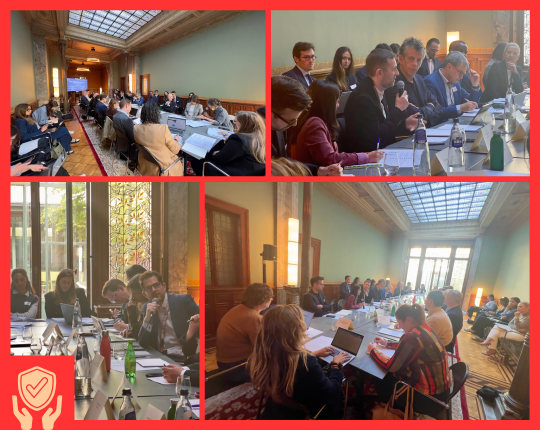
Décideurs politiques, dirigeants d’entreprises, universitaires et représentants de la société civile se sont retrouvés à Bruxelles autour d’une table ronde de notre think tank
De nombreuses personnalités ont contribué à l’échange que La villa numeris proposait, «Améliorer la sécurité des enfants en ligne: constat, défis et solutions», dans la capitale européenne, à La Maison de la Francité, le 15 avril 2026.
Sens de l’écoute et des responsabilités étaient au rendez-vous. Face aux menaces réelles de l'exposition à des contenus violents et au développement de comportements addictifs, une réponse appropriée relève de l’engagement de tous.
Le système déclaratif de l'âge ne suffit plus. Les pistes alternatives ont été abordées en profondeur. Des solutions européennes harmonisées, comme le portefeuille d'identité numérique, pourraient permettre de vérifier l'âge grâce à des technologies respectueuses de la vie privées sans divulgation des données sans que les plateformes n'accèdent à l'identité réelle des jeunes.
Au-delà, l’accès aux réseaux sociaux n’apparait pas comme pas une solution miracle. Exclure les jeunes sans leur offrir d'alternatives risquerait de les priver d'espaces sociaux. De plus, le risque apparait comme grand de les pousser vers des zones numériques moins régulées. L'objectif doit rester de protéger sans isoler, en garantissant un équilibre avec leurs droits fondamentaux, comme la liberté d'expression et l'accès à l'information.
:: Pour aller plus loin
- Résumé. Réservé à nos membres 🔐 >> Télécharger
Protecting the most vulnerable is everyone’s responsibility
Policy makers, business leaders, academics, and representatives of civil society gathered in Brussels for a roundtable discussion organized by our think tank
Many prominent figures contributed to the discussion organized by La villa numeris, titled “Improving Child Safety Online: Evidence, Challenges, Solutions” which took place in the European capital, at La Maison de la Francité, on April 15, 2026.
A willingness to listen and a sense of responsibility were evident. In the face of real threats posed by exposure to violent content and the development of addictive behaviors, an appropriate response requires everyone’s commitment.
Self-declaration of age is no longer sufficient. Alternative approaches have been discussed in depth. Harmonized European solutions, such as the digital identity wallet, could enable age verification using privacy-respecting technologies without data disclosure, without platforms accessing young people’s real identities.
Beyond that, restricting access to social media does not appear to be a miracle solution. Excluding young people without offering them alternatives risks depriving them of social spaces. Furthermore, there is a significant risk of pushing them toward less regulated digital spaces. The goal must remain to protect without isolating, ensuring a balance with their fundamental rights, such as freedom of expression and access to information.
:: Learn more
- One pager. For members only 🔐 >> Download
Speakers
Open discussion with selected policymakers, leading academics, civil society and industry representatives
Opening remarks
|
European People's Party, Spain (to be confirmed) |
 Member of the European Parliament Pablo Arias Echeverría;
Session 1: Assessing International Initiatives on Online Protection of Minors
We will examine recent international initiatives as case studies, including the Australian Social Media Ban. Following opening remarks from Pr. Valère Ndior (University of Brest), speakers will assess the available evidence on the rationale, design, and implementation of these approaches, including operational roll‑out, enforcement, effects on young users, and implications for data protection and privacy.
 |
 |
 |
|
Valère Ndior Law Professor / Université de Bretagne Occidentale |
Alain Strowel Professor / UCLouvain |
Martin Harris Hess Head of Sector for Protection of Minors Online / DG Connect |
 |
 |
 |
|
Inès Legendre Advocacy officer / Association e‑Enfance (3018) |
Jean Gonié Senior Director, EMEA Public Policy / Snap Inc. |
Francesca Pisanu EU Advocacy Officer / Eurochild |
Session 2: Age Verification and Digital Identity: Feasibility, Proportionality, and Fundamental Rights Compliance
We will focus on age‑verification mechanisms and the conditions under which they could be deployed in a way that is technically reliable, privacy‑preserving, and compatible with EU fundamental rights. Following opening remarks from researcher Martin Sas (KU Leuven), the discussion will position age verification within the broader context of digital identity deployment, and review existing and emerging models to discuss what a proportionate age‑verification framework could look like, should the EU consider harmonised requirements for age verification across Member States.
 |
 |
 |
|
Martin Sas Doctoral Researcher / KU Leuven |
Jutta Croll Chair of the Board of Directors / Stiftung Digitale Chancen |
Jessica Galissaire Senior Policy Researcher, Digital Public Sphere / Interface |
 |
 |
|
|
Johan Bodenkamp EU Programme & Policy Officer / DG CONNECT |
Bruno Studer Former French Member of Parliament |
Closing remarks
 Leanda Barrington-Leach, Executive Director / 5Rights